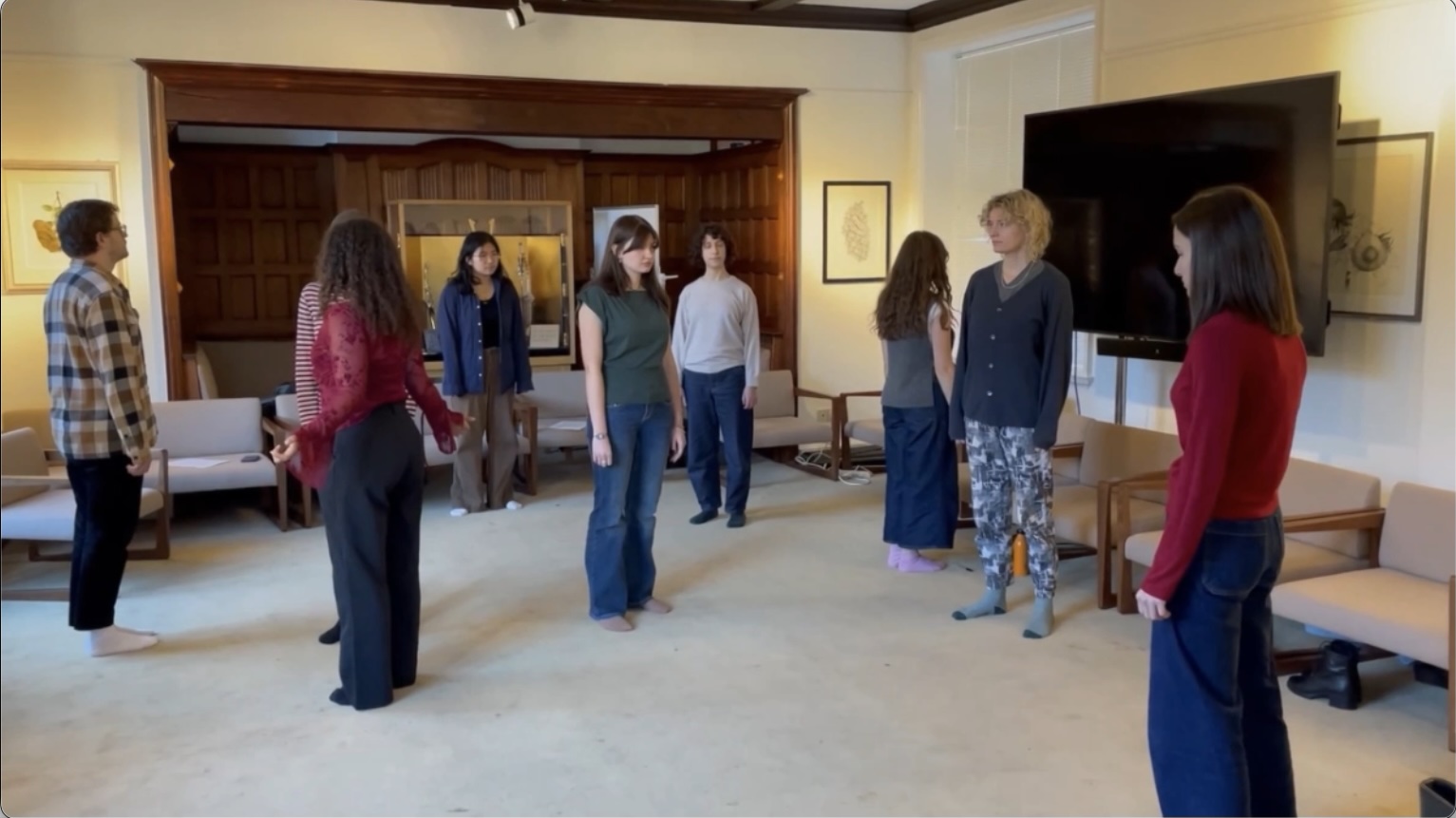
A one-day practice-research workshop exploring translation as an embodied and dramaturgical process through performance.
Taking as its starting point Cassandra’s speech in Michael Hospenius’ neo-Latin Equus Troianus, performed by students in Strasbourg in 1590, the workshop investigated what happens to meaning when a text moves from page to body, space, voice, and collective action. Through retelling, spatial mapping, vocal work, and creative rewriting, participants tested early modern and contemporary translations alongside new material generated in the room.
Bringing together early career researchers, practitioners, and students, the workshop worked across textual and visual materials: from Aeschylus, Seneca, Virgil, and Hospenius to ancient and contemporary representations of Cassandra and materials selected by the participants themselves. The process explored recurring dramaturgical tensions—visibility and exclusion, festivity and destruction—and traced Cassandra’s transformation from a marginalised figure into a collective voice.
- Director and Dramaturg: Giovanna Di Martino.
- Participants: Sophie Bassano, Alice Bowen Tan, Tara-Louise Clark, Tyra Dreise, Alexandra Holmes, Zoë Jennings, Francesca Beretta, Carla Suthren, and Daniel Whittle. Location: St Anne’s College, University of Oxford.
- Texts: Aeschylus, Agamemnon; Seneca, Agamemnon; Virgil, Aeneid 2; Michael Hospenius, Equus Troianus (1590).
- Funding: British Academy / Leverhulme Trust.